
How to Build Functional Muscle Safely After Age 40 Without Heavy Weights
Aging changes how the body responds to training, but it does not mean you have to give up on building real, usable strength. After 40, the goal shifts from chasing maximum loads to training smarter. You can build functional muscle without ever touching a heavy barbell or risking joint pain.
Functional muscle is the kind of strength that helps you carry groceries, play with your kids, hike uphill, and get up from the floor with ease. It is not about how much you can bench press. It is about how well your body moves through daily life.
Here is how to build that kind of muscle safely, using bodyweight, bands, and moderate resistance.
Why Heavy Weights Are Not Necessary After 40
Heavy lifting works, but it also carries higher joint stress, longer recovery times, and greater risk of injury as connective tissue loses elasticity. Tendons and ligaments recover slower than muscle. After 40, the smart approach is to create enough tension to trigger muscle growth without exceeding what your joints can comfortably handle.
Moderate loads, slow tempos, and higher volumes can produce similar muscle-building results with far less wear and tear. The key is progressive overload, not absolute load.
Train Movements, Not Just Muscles
Functional strength comes from training movement patterns rather than isolating single muscles. Focus on these core patterns:
Push
- Push-ups on an incline, floor, or against a wall
- Band chest presses
- Overhead band presses
Pull
- Bodyweight rows using a table or low bar
- Band rows
- Doorway pull-up assists
Squat
- Bodyweight squats
- Split squats
- Box squats to a chair
Hinge
- Glute bridges
- Single-leg hip hinges
- Band pull-throughs
Carry and Core
- Farmer carries with moderate dumbbells or grocery bags
- Dead bugs
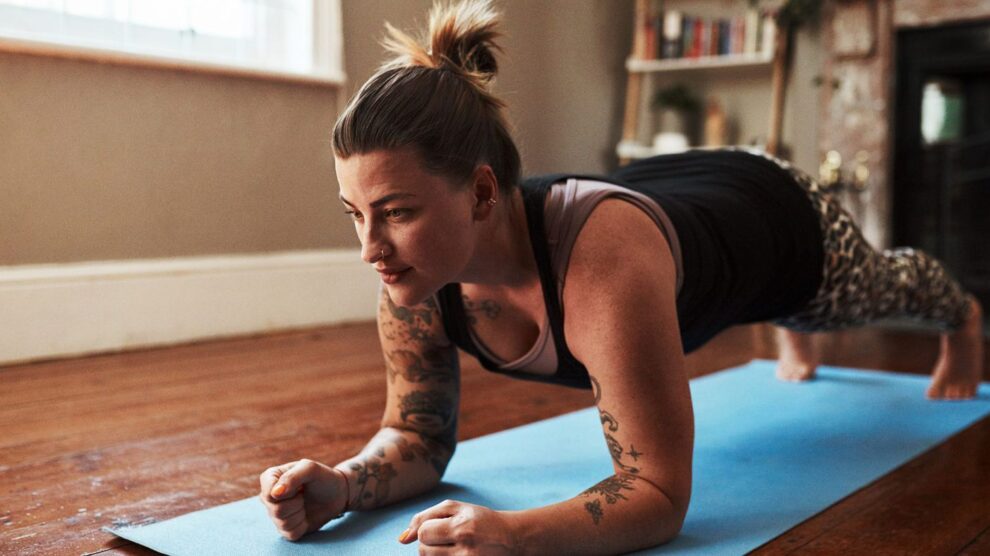
- Side planks
Each pattern translates directly to real-life tasks. Master the movement first, then add resistance slowly.
Use Time Under Tension to Your Advantage
One of the safest ways to make lighter resistance feel harder is to slow down. Slowing the lowering phase of any exercise increases time under tension, which stimulates muscle growth without adding weight.
Try this tempo:
- Lower for 3 seconds
- Pause for 1 second at the bottom
- Press or pull up for 1 to 2 seconds
A set of 10 slow push-ups can feel harder than 20 fast ones. This approach builds control, stability, and muscle with minimal joint stress.
Prioritize Unilateral Training
Unilateral exercises work one side of the body at a time. They expose and correct imbalances, improve balance, and allow meaningful training with less total load.
Examples include:
- Single-leg Romanian deadlifts with a light dumbbell
- Split squats
- One-arm band rows
- Single-arm overhead presses
Because you are lifting half the weight you would use bilaterally, your joints take less total stress while each limb still works hard.
Use Bands for Variable Resistance
Resistance bands are one of the best tools for building functional muscle after 40. Unlike free weights, bands provide increasing resistance as they stretch. This matches your strength curve and feels easier on the joints at the start of a movement while still challenging the muscle through the full range.
Bands are also portable, inexpensive, and ideal for home workouts. You can perform presses, rows, squats, hinges, and rotational movements with a single set of loop bands.
Focus on Recovery and Frequency
After 40, recovery becomes the limiting factor for progress. Training more frequently with moderate intensity often works better than grinding through long, exhausting sessions.
A simple schedule:
- Train 3 to 4 days per week
- Keep sessions between 20 and 40 minutes
- Alternate between upper and lower body focus or full-body circuits
- Take one full rest day between strength sessions when sore
Sleep, protein intake, and walking on rest days all support muscle repair and growth.
Progress Without Adding Weight
Progressive overload does not require heavier dumbbells forever. Increase difficulty by:
- Adding one or two reps per set
- Reducing rest time between sets
- Slowing the tempo further
- Moving to a harder variation, such as elevating your feet on push-ups
- Adding a one-second pause at the hardest point of the movement
Small, consistent progress adds up. Tracking your workouts in a notebook or app helps you see the trend and stay motivated.
Start With a Simple Weekly Plan
Here is a sample full-body routine you can do three times per week with just your body and a resistance band:
Workout A
- Incline push-ups: 3 sets of 8 to 12
- Band rows: 3 sets of 10 to 15
- Bodyweight squats to a chair: 3 sets of 10 to 15
- Glute bridges: 3 sets of 12 to 15
- Dead bugs: 3 sets of 8 per side
Workout B
- Split squats: 3 sets of 8 per leg
- Band overhead presses: 3 sets of 10 to 12
- Single-arm band rows: 3 sets of 10 per arm
- Single-leg hip hinges: 3 sets of 8 per leg
- Side planks: 3 sets of 20 to 30 seconds per side
Alternate between Workout A and Workout B each session.
Listen to Your Body and Adjust
The most important rule after 40 is to respect your body’s signals. Soreness is normal. Sharp pain is not. If an exercise hurts, change the angle, reduce the range of motion, or swap it for a variation that feels comfortable.
Building functional muscle safely is a long game. Consistency, controlled movement, and smart progression will deliver strength that lasts for decades, not just for a season.



Add Comment