

Understanding the Diaphragm as a Core Muscle
Most people think of the core as the six-pack muscles on the front of the abdomen. In reality, the core is a three-dimensional cylinder that includes the deep abdominals, the spinal erectors, the pelvic floor, and one commonly overlooked muscle: the diaphragm.
The diaphragm sits at the base of the ribcage and serves as the roof of that cylinder. Every breath you take either reinforces or disrupts the stability of your trunk. When breathing is shallow and chest-dominant, the diaphragm fails to descend fully, which leaves the lower back without the internal pressure support it needs during movement.
Restoring proper belly breathing mechanics is one of the most effective, low-cost ways to reduce back tension and improve core stability without doing a single crunch.
How Shallow Breathing Leads to Back Tension
When you breathe primarily into the upper chest, several compensations occur. The neck and shoulder muscles lift the ribcage with every inhale, which can create chronic tightness in the upper traps and scalenes. At the same time, the lower ribs remain stiff, and the diaphragm loses its full range of motion.
This creates a stability gap in the lumbar spine. Without proper intra-abdominal pressure generated by a descending diaphragm, the small stabilizer muscles of the lower back must work overtime. The result is often a feeling of stiffness, fatigue, and guarding in the low back that persists even after stretching.
Over time, poor breathing mechanics reinforce poor posture, which then reinforces poor breathing mechanics. Breaking this loop starts with retraining the breath.
Belly Breathing as a Core Stability Tool
Belly breathing, also known as diaphragmatic breathing, encourages the diaphragm to move downward on the inhale. This downward movement gently presses the abdominal contents forward and outward, which is why the belly rises. On the exhale, the diaphragm relaxes upward and the abdominal wall draws back in.
This simple motion creates a rhythmic, low-level activation of the deep core muscles, including the transverse abdominis and the pelvic floor. Unlike bracing exercises that create high tension, belly breathing teaches the core to regulate pressure in a graded, coordinated way. That is precisely what a healthy spine needs during daily activities like walking, lifting, and sitting.
The 360-Degree Breath
A common mistake is pushing the belly forward without allowing the ribs and lower back to expand. The most effective belly breath for core stability is a 360-degree breath. On the inhale, you should feel expansion not just in the front of the belly, but also into the sides of the lower ribs and the back.
This full circumferential expansion allows the diaphragm to descend evenly and distribute pressure around the entire trunk. It also prevents the lower back from being pushed into excessive arching or flattening.
Simple Drills to Retrain Your Breathing Mechanics
Retraining your breath does not require a gym or special equipment. These drills can be done daily, ideally for five to ten minutes.
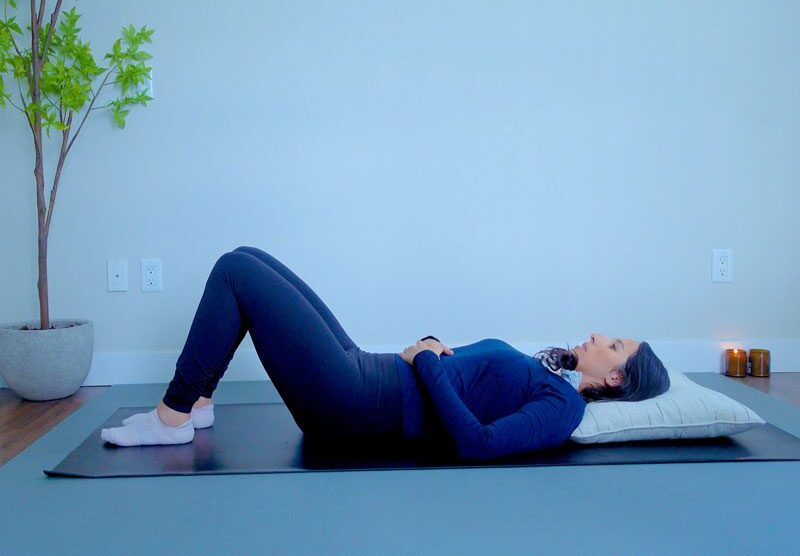
1. Crooked Hooklying Breath
Lie on your back with your knees bent and feet flat on the floor. Place one hand on your belly and one hand on your lower ribs. Inhale through the nose for three to four seconds, allowing the belly to rise and the ribs to expand sideways. Exhale slowly through the mouth for six to eight seconds, letting the ribs soften and the belly fall. Repeat for two to three minutes.
2. Seated 360-Degree Breathing
Sit on a firm chair with your feet planted and your spine tall. Place your hands around your lower ribs, thumbs pointing toward your back. Inhale and feel your ribs press into your hands in all directions. Exhale fully and feel the ribs narrow. This drill is especially useful for people who sit for long periods and notice low back fatigue by mid-afternoon.
3. Breathing with Gentle Core Engagement
Once belly breathing feels natural, add a light core cue. On the exhale, imagine gently drawing the lower belly away from your waistband without gripping hard. The inhale should still be full and relaxed. This teaches the core to maintain tone while allowing the breath to flow, which is the foundation of functional stability.
When to Expect Results
Most people notice a reduction in back tension within one to two weeks of consistent practice. The key is frequency rather than intensity. Two short sessions per day are more effective than one long session done occasionally.
Belly breathing is not a substitute for strength training or medical care when back pain is severe, but it is an essential foundation. When the breath is calm and the diaphragm moves well, every other core exercise becomes more effective, and the lower back finally gets the support it has been asking for.



Add Comment